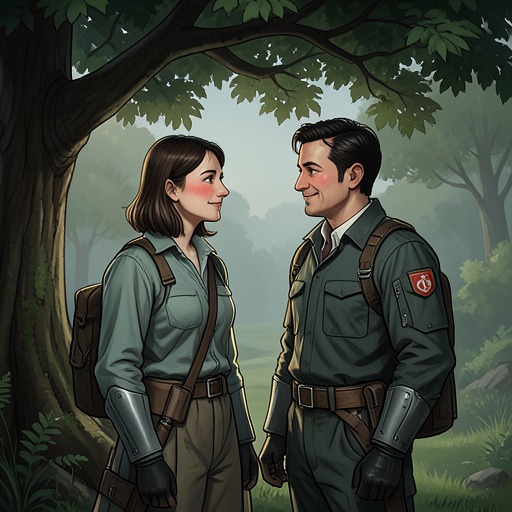
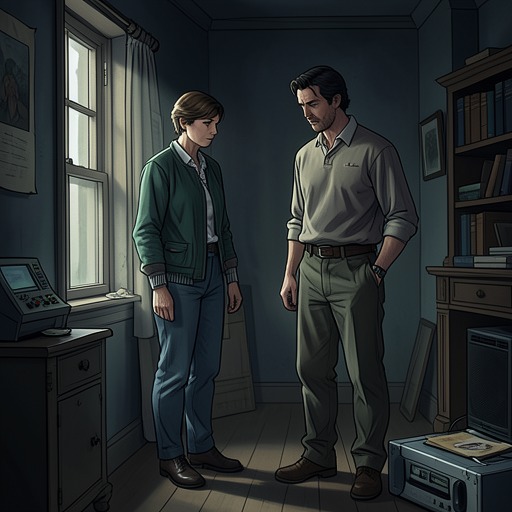
Jake and Helen are trapped in the hotel elevator
Happiness for BeginnersJake and Helen are trapped in a hotel elevator at the moment when Jake finally tells her that he is losing his sight and cannot stop it. The malfunction first strands them, then jolts them toward the floor; Jake’s confession gives the danger a deeper emotional charge, while the rescue turns their private crisis into a public beginning. Helen later identifies the scene as a memory she returns to when she needs to remember happiness: not because it promises an easy future, but because, in that moment, she and Jake begin to face the future together.
Background and Delayed Disclosure
Jake’s diagnosis had been shaping the journey long before the elevator failed. He had initially signed up for the trip, canceled, and signed up again; he explains that he withdrew because he was having trouble with his eyes. Examinations and tests established that he had an inherited vision disorder that could not be fixed. Night blindness was one part of it, not the whole condition.
For the past year, Jake had used his pre-medical-school training to investigate what was happening. His conclusion was stark: he could only wait for the light to go out. The diagnosis had already changed how he imagined his future, but he had carried that knowledge on the wilderness trip without disclosing its full weight to Helen. She sees the contrast between his capable, independent manner and the fear he has been carrying while other people, herself included, complain about more immediate discomforts.
His father’s expectations deepen the personal stakes. Jake says his father calls him Doc and sees him as the son he has always intended him to become: high-achieving, hardworking, and a valedictorian. Losing his sight threatens more than a medical career; it unsettles the future his father has imagined for him, too. Jake had also pictured ordinary and adventurous experiences he might lose: revisiting his childhood home and a park merry-go-round, looking through family photographs, scuba diving, driving a race car, and riding a roller coaster.
The Elevator Fails
The elevator becomes immobile despite Helen pressing the lobby button repeatedly. The doors will not open, either, and she realizes they are trapped. Jake answers her alarm with apparent approval, a response that briefly sharpens the difference between his attitude and hers. When the car later drops about six inches, both freeze and crouch, waiting to see if it will move again. Neither knows whether Jake’s palm striking the wall caused the jolt or whether it was coincidence.
Jake then tests the controls: the door button, the lobby button, and finally every button at once. Nothing works, so he presses the alarm. A voice answers and asks whether they need help. Jake reports that they are stuck. The response is apologetic but not reassuring: staff had thought the elevator was fixed, and someone will come to pry the doors open. When Jake asks how soon, the voice has already disappeared. He steps back against the wall to brace himself.
The stalled car makes a confined stage for a disagreement that is already larger than the immediate emergency. Helen insists that she does not want only what she cannot have, invoking the lesson she has drawn from her marriage to her ex-husband: she wants to count her blessings and be satisfied with what life gives her. Jake bursts out that he is trying, slamming his palm against the elevator wall. The small drop that follows does not resolve their disagreement; it makes their precarious situation briefly, unmistakably physical.
Confession and Second Drop
In the elevator, Helen challenges Jake about why he did not tell her what was happening. He explains that he had not been certain until shortly before Wyoming. He had gone through denial and bargaining and undergone numerous tests to learn how severe the condition was. Once he knew, he says, he could not breathe or eat. The future he had wanted—to become a doctor, have children, and learn to scuba dive—seemed to vanish. He places that moment on the day before Helen arrived at a party with Pickle.
Jake’s disclosure is not a claim that the prognosis might change. He tells Helen that, within the next few years, his eyes will go dark and nothing can change that. He admits that he believes a better person would leave her alone, but he cannot make himself do so; he has come to be brave and tell her the truth. The confession links the medical fact to the choice he has postponed: pursuing a relationship while knowing that his sight will progressively fail.
Helen recognizes that the elevator has put them on opposite sides of the car when she wants to be close to him. Before she can cross the space, the elevator drops again, this time by a foot or two, and both land facedown on the carpet. Jake commando-crawls to check whether she is all right. He tells her they are stuck between floors fourteen and twelve; when she asks about thirteen, he explains that there is no thirteenth floor. The exchange brings a brief, concrete absurdity into a moment charged by the possibility of injury and the enormity of what Jake has revealed.
Rescue and the Memory Helen Keeps
The elevator doors eventually open several feet below the level of the floor. Three firefighters peer down, with a hallway full of middle-school students behind them. After clearing the crowd, the firefighters lower a ladder and confirm that the car has been secured and is safe to climb out of. The rescue does not erase the frightening drops or the confession; it brings the trapped pair into a lobby where their private closeness is suddenly visible to everyone.
David Hoffman and Darcy are among the onlookers, along with Grandma GiGi and her new gentleman friend in a bow tie. Duncan has rolled up his shirtsleeves and popped his collar. He cheers for Helen, then calls out a special salute to Jake. The crowd’s cheers turn the escape into a celebration. Jake helps Helen up, and the two wave and take a bow; at Duncan’s urging, Jake reaches for Helen and kisses her. The crowd falls silent, or seems to, as Helen attends to the kiss rather than the watching students, her brother, her grandmother, or their friends.
Helen tells this episode retrospectively as the memory she reaches for when thinking about happiness. She knows that heartbreak, sadness, and trouble lie ahead, but understands that they will meet hardship better together than apart. The scene’s resolution is therefore not a cure for Jake’s condition or a guarantee against future pain. Its decisive change is relational: amid a breakdown neither of them can control, Jake tells the truth, Helen stays close, and their first kiss gives the memory its lasting force.